
Update: Sanara Medtech
Three and a half years after the original write-up, it's time for an update

It’s been roughly 3.5 years since my original write-up on Sanara Medtech. A lot have changed since then, so I figured it was time for an update.
One thing that haven’t changed – as much as I thought it would at least – is the share price, which at the time of the original write up was $29, while the current share price is around $35. My opinion is that Sanara’s underlying fundamentals has improved drastically since 2021, but with a share price that has only increased 20% in 3.5 years (a CAGR of 5.52%.. yikes) there’s obviously some not so great things too. While most posts focus on the positives first, I want to start with the negatives as it offers a possible explanation of the current sentiment. I’ll then highlight all the positive developments and why I believe Sanara is a diamond in the rough, so stick around to the end.
The company was probably overvalued in 2021
Trading at an EV/run rate sales of ∼10x as of the 1Q21 report, the company was probably quite a bit overvalued. But then again, which company wasn’t in 2021. Nevertheless, buying companies valued for perfection rarely turns out well – especially microcaps.
Sanara is still not profitable
While the question of profitability requires some nuance in Sanara’s case, the fact of the matter is that the company still isn’t profitable. Ron Nixon (Chairman and CEO) told investors back in 2022 that he expected the company to achieve breakeven – on a cash flow basis - in 2023. That still hasn’t happened and leaves the question that has always followed Sanara: are they able to achieve operating leverage with their commission based sales rep model? More on that later, but for any investor taking a surface level look at the company, they will probably be skeptical at best. Missing guidance by several quarters certainly doesn’t help either.
The company took on a significant amount of debt in 2024
It’s not enough that the company isn’t profitable, but they announced a $55m debt facility in April of 2024. As of 3Q24, roughly $30m has been drawn, which carries an interest rate of 13.25%. At this point I bet you’re thinking “not profitable, with $30m in debt, at 13% interest – yuk, no thanks”. You would not be alone. I think that line of thinking pretty much summarizes investor sentiment for Sanara.
A one-trick pony still
Sanara is largely a one-trick pony still. While we don’t have an exact breakdown of revenue per product, the company does break down revenue per segment. Soft tissue products produce roughly 85-90% of the company’s revenue, and of this, CellerateRX makes up the vast majority. This is the same dynamic as in 2021. The thesis back then was the Sanara would add several more products which would produce significant revenue and in turn operating leverage. That’s not quite how things played out – yet.
No moat
Investors familiar with the wound care space will know that there is a ton of other wound care products on the market. A lot of them offer no differentiation. The question then becomes; does Cellerate? I don’t think many investors are convinced that the answer to that question is yes.
The black box that is Tissue Health Plus (THP)
The company has talked about launching a “telehealth platform” since 2021. Since then the solution has gone through many different iterations, finally ending up as Tissue Health Plus. While THP has its own website now, showing the company’s solution, Sanara is not sharing much in terms of what investors can expect once it launches. That’s understandable given that it’s early days, and I can appreciate the company under promising (or not promising at all) and hopefully overdelivering, but it does leave investors questioning if this money burning machine will be worth it. How much money are they burning on THP you ask? In their 3Q24 report, the company expected to spend another $5-10m through mid-2025. That’s a significant amount for an unprofitable company, not to mention how much they’ve spent on it already.
So that’s the “bear thesis”; Sanara is an unprofitable, mainly one product company, with a lot of debt, pouring money into an uncertain business venture. It certainly doesn’t sound or look great, but let’s turn to the positives, which in my opinion far outweigh the negatives.
How big of a problem is the lack of profitability?
Related to profitability and operating leverage, one common question I hear investors asking is; with Sanara selling their products through 1099 sales reps who take a commission, isn’t their gross margin overstated (90%) and how profitable can they really get? Firstly, yes, their gross margin is overstated. While Sanara doesn’t disclose what commission % they pay their sales reps, I think a good assumptions is that it is in the 10-40% range. So conservatively, one can assume that GM is around 50%. Luckily, other than SG&A (commissions), Sanara’s business model doesn’t require much fixed-cost or capex. Who knows what margins will look like at maturity, but I don’t think EBITDA margins of 20%+ is unrealistic.
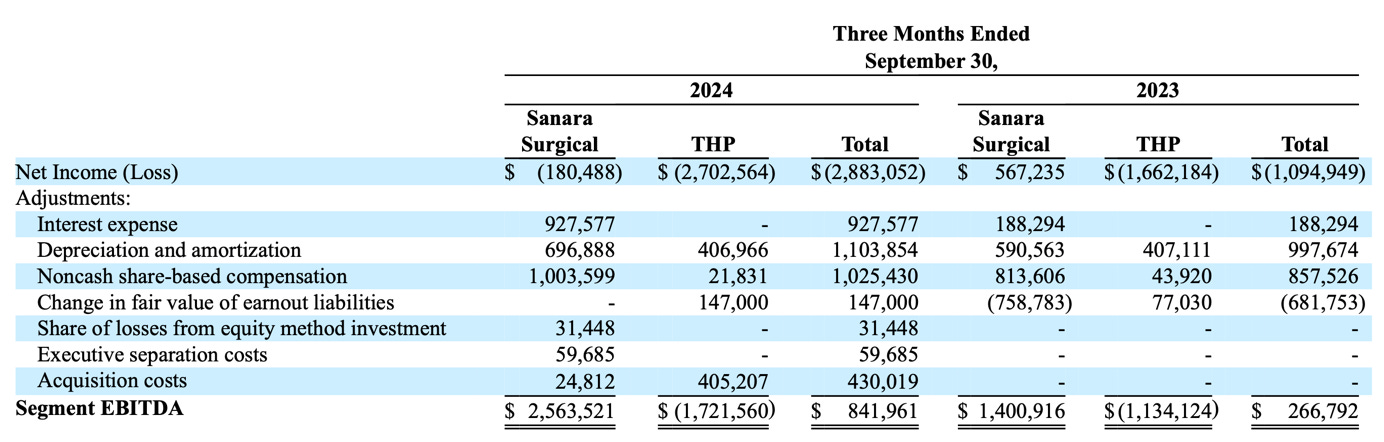
Let’s dive a bit deeper. If you look at the underlying economics, you’ll see that Sanara is choosing to be unprofitable. Below is the segmented economics for Sanara. Surgical, which is the only segment producing revenue for the company, is EBITDA positive. In fact, from 3Q23 to 3Q24 EBITDA increased 83%. Revenue in that same time period increased 35%. Did someone say operating leverage?
Alright, let’s be critical here for a second. The company adjusts for noncash share-based comp to get to EBITDA. Many investors, myself included, often times argue that this should be considered a true cash expense. Fair enough. Removing SBC, EBITDA is still positive at roughly $1.5m. Doing the same to 3Q23 EBITDA ($586k) the increase in EBITDA year-over-year becomes 166%. Let’s be even more conservative and back out another recurring cash expense, namely interest expense. Doing so should get us close to cash flow excl. WC and one-offs (we don’t have segmented WC), which gives us CF of $632k.
Is this analysis perfect? No. However, it certainly gives us an idea over what the underlying profitability looks like for Sanara, excl. THP. While an EBITDA margin of 11.8% isn’t bad, it will hopefully be much higher at maturity. Still, the surgical business is currently growing revenues 30% and EBITDA more than twice that. The worries around operating leverage should at the very least be dampened.
The debt
I’m not here to convince anyone that taking on debt as an unprofitable company is a good idea. But in this case, where you have a company with underlying profitability, masked by a money burning vertical, I would much rather have them raise debt than issue a ton of stock, as diluting shareholders in the low $30s/high $20s would certainly hurt as well. At least now, with the debt, the co has the ability to prove out THP, continue to grow the surgical side, do M&A, and increase revenues and profitability, all without diluting. It also gives them the optionality of raising from a strategic after the THP launch, hopefully at a much better price. Come 2029, when the debt matures, I believe Sanara will be a much different company who can service their debt and be able to re-finance if need-be. So while I agree that debt isn’t great in most cases for money-burning companies, I think it was pretty shrewd capital allocation by the company in this case. I know many investors will disagree with this, so I will respectfully agree to disagree on this point.
No mo’ one-trick pony
While it is true that Cellerate produces 80%+ of the Sanara’s revenue, they are slowly but surely adding more products. Let me be more precise, the company has several products, it’s just that most of them produce relatively little revenue. Let’s therefore focusing on the products that Sanara believes can produce real revenue in the future:
- Biasurge: Approved in April of 2023, the company believes the product will serve as a platform-product similar to Cellerate in the future, meaning $100m+ revenue yearly. They have been selling the product for a little over of a year now, and the company says sales are ramping nicely, but as with most products, it takes time.
- Investment and distribution agreement for OsStic: Sanara recently acquired the exclusive U.S. marketing, sales, and distribution rights to OsStic. At the same time they bought approximately 12.5% of Biomimetic Innovations Ltd (the owner of OsStic), for up to $8m. While the product isn’t available until Q1 2027, Sanara’s management probably wouldn’t do this deal unless they thought OsStic could be a platform product ($100m+ yearly revs)
- JV with InfuSystems (SI Healthcare Technologies): Pairs INFU’s negative pressure wound therapy products with Sanara’s wound care products. Difficult to say what the potential is, but both companies believes it could be significant
- Chemo Mouthpiece: SI Healthcare secured the exclusive distribution rights to the product, while Sanara also invested $5m into the company (ChemoMouthpiece LLC). This suggests that Sanara believes this can be another $100m+/year product
- Tissue Health Plus: We’ll look at this vertical more later, but with the amount of money Sanara is spending on developing it, they must think the potential is massive
As I mentioned earlier, the thesis back in 2021 was that the company would add more products that could produce meaningful revenue, which in turn would produce operating leverage as one sales rep could sell several products instead of one. While there’s already signs of op lev showing up, the profitability should only increase as Sanara layers on all of these products. They are still building a wound care portfolio full of products which the company believes can act like platform products, it has just taken longer than expected.
So what about the competition?
There’s a ton of competition in wound care, and there most likely isn’t very much differentiation. That alone turns a lot of investors away from investing in companies like this. With that being said, look at CellerateRX. Back in 2021 when I did my original write up, Sanara did $24m in revenue for the full year. They now do $24m in revenue, in a quarter. That’s some serious growth. What’s the reason for that growth? Is Sanara’s 1099 reps that much better than everyone else? I doubt it. Is Cellerate that much better than the competition? I can’t really say, there hasn’t been done any comparative studies that I know of. But isn’t the proof in the pudding, so to speak? How can a product grow that much, in an industry like health care, if it isn’t better than the alternative? Sure, I realize that I might sound naïve here, and the argument isn’t that Cellerate isn’t good, but since you can’t prove it’s better than the other products, it can easily be outcompeted if a better product comes along. That’s a fair pushback. How many companies, especially microcaps, can you make that same argument about though? My guess is, most.
But let’s take a closer look at the competition. It’s difficult to get an overview over all the products that are out there. From what I’ve been able to find, there isn’t much that’s similar to Cellerate.
If I look at other collagen products like Promogran Prisma, which I realize is intact collagen versus Cellerate’s hydrolyzed collagen so maybe not a perfect comp, it seems like Promogran Prisma is suitable for wounds with high exudate and inflammation, while Cellerate is mostly used for wounds with low to moderate exudate. Promogran Prisma’s silver component (which also helps with infections) also makes it a more high cost product. It has a longer delivery period because it’s intact collagen. So it doesn’t feel like a direct competitor to Cellerate.
I’ve also looked at products like Endoform Dermal Template, Purcal Plus, and Stimulen Collagen Gel/Powder - which are all collagen products. But similarly to my understanding of Promogran Prisma, all these products are used for wounds with moderate to high exudate, longer delivery time, higher cost, etc.
Compare this to Cellerate that is for wounds with low to moderate exudate, easy to apply, short delivery time, low cost, and there really aren’t many good comps out there (that I’ve been able to find at least). This also fits with management’s comments about how their biggest competitor is the surgeon not applying anything to the wound.
Board member
I quickly wanted to mention that Sanara also added Keith Myers to their board in 2024. Mr. Myers is the chairman and CEO emeritus of LHC Group, one of the largest and highest quality in-home healthcare providers in the United States. He co-founded LHC Group in 1994 and led its growth from a single freestanding home health agency in rural Louisiana to a publicly traded company with 29,000 employees and 950 agency locations across 38 states and the District of Columbia. In other words, a huge add for Sanara. Looking at the rest of Sanara’s board as well, it’s easy to see that this is not a typical microcap company board.
Tissue Health Plus
This is the section I should probably spend the most time on, but quite frankly, it’s difficult to analyze as we don’t know much. If you go their website (https://www.tissuehealthplus.com) you can now see what the company is planning to offer. Looking at their offering, it’s super impressive, so impressive that it makes me nervous because it feels like they won’t be able to do it.
Stats from LinkedIn shows that they have been hiring like crazy, going from a handful of employees in July 2024 to now being close to 40 employees. These aren’t just nobodies either, they have been able to recruit some seriously impressive people.
The guided spend and increase in employees reaffirms that Sanara is serious about THP and believes that it can be massive. They are expected to launch their pilot in 1H25 and commercially launch in 2H25. Who knows what the ramp will look like – another question making most investors hesitant. Sanara has also said that they are looking for a strategic partner once they launch, so they don’t have to pay for the ramp themselves. Who knows if they will be able to land that.
In sum, there’s a lot of unknowns and unanswered questions surrounding THP. As an investor, I think you simply have to ask yourself if you believe in Sanara’s vision for THP and if they have the ability to execute it. Having Ron at the helm, and now Keith on the board, certainly helps my conviction. This is as much of a jockey bet than believing in THP.
Valuation
While the company was overvalued in 2021, I would argue that the company is currently undervalued. Trading at an multiple of 3.3x EV/run rate sales (excl. the Biasurge bump), it certainly isn’t expensive when looking at peers, which trades at around 5-6x 2025e EV/sales. Assuming that Sanara rerates to baseline multiples by the end of the year, what would that look like?
If we assume 25% revenue growth, which I think is very doable, we’re looking at 2025 revenue of $108m. At a multiple of 5x EV/sales, that translates to a share price of $62. Looking at EBITDA, it wouldn’t be surprising if run rate EBITDA is $15-20m, which would translate to an EV/EBITDA of 16-20x. One could argue that’s not expensive for a company growing EBITDA close to triple digits and not being close to scale. Remember, this is for the surgical side alone. We’re not pricing in any of THP which the company is sinking millions over dollars in to. Valuing the company 69% higher than the current share price, while assigning zero value to a big chunk of the business, should provide ample margin of safety.
Conclusion
I believe the bear thesis for Sanara is pretty obvious and explains the current valuation. Despite the obvious negatives, I do think you’re getting a lot for the price you’re paying; Cellerate, Biasurge ramping, 30%+ revenue growth, operating leveraging coming along, InfuSystems JV, M&A deals, very high quality management team, and close to zero institutional ownership - all at a historically low multiple for the company. That’s just the surgical side though. You get THP for free at the current valuation. In fact, I believe if Sanara spun-off or divested THP, the share price would trade higher than it currently is.
While most investors currently seem unconvinced about Sanara, I believe that can, and will, quickly change in the not so distant future.